Velocity ratio – Definition, Formula, and its different purposes
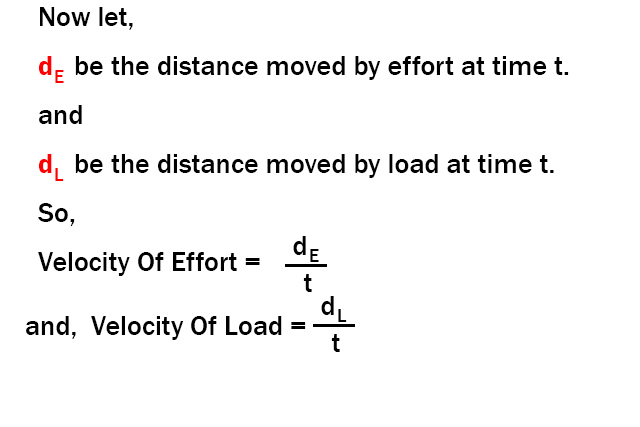
Velocity ratio is the ratio of the distance moved by the effort to the distance moved by the load in a machine.
Or,
Velocity ratio can be defined as the ratio of the velocity of the effort to the velocity of the load in a machine.
Velocity ratio is a dimensionless constant.

We know that,

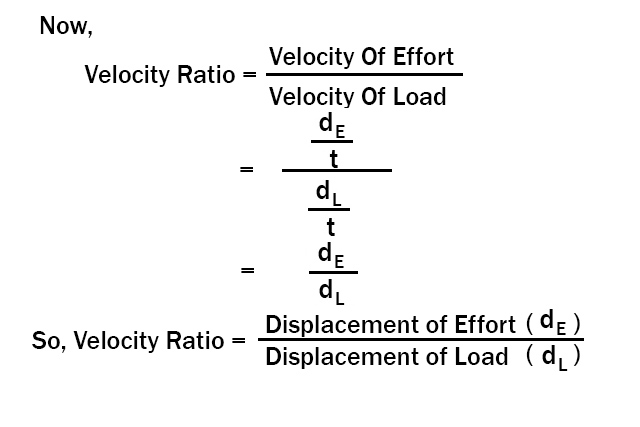
There are three conditions in the Velocity Ratio. They are:-
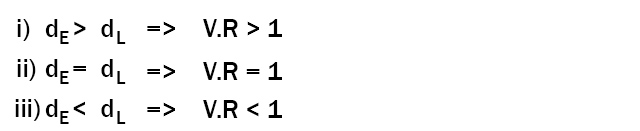
Based on the Velocity ratio value, we can determine the following,
If dE > dL => VR > 1, then there is speed loss and the machine is a force multiplier, e.g., a pliers

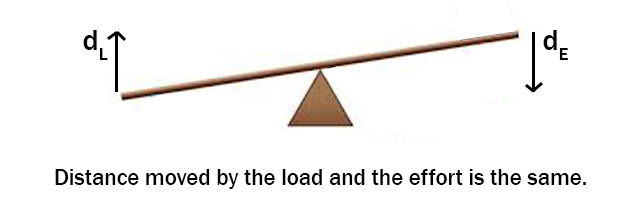
If dE = dL => VR = 1, then the distance moved by the load and the effort is the same.
If dE < dL => VR < 1, then there is force loss and speed gain. e.g. long scissors.
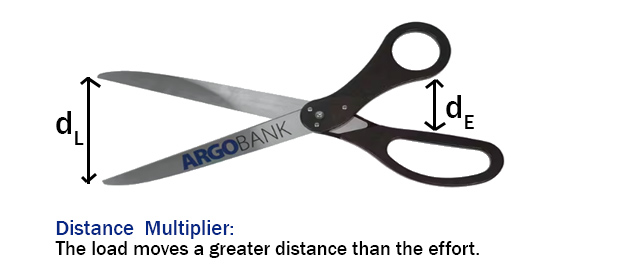
VR indicates the machine motion transformation, whether the machine is a force multiplier or a distance or speed increaser.
For an ideal frictionless machine, the Velocity Ratio is equal to the Mechanical Advantage.
But in reality, Mechanical Advantage is always less than Velocity Ratio due to friction, making efficiency less than 100%.
Note:
Unlike the mechanical advantage, the velocity ratio of a machine of a particular design is always constant.